










XDeep Stealth 2.0 TEC vs REC:
Why the TEC Version Dominates Sidemount Diving
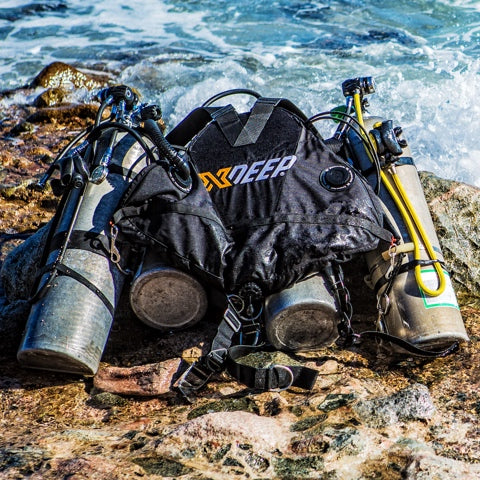
The XDeep Stealth 2.0 TEC offers significantly more lift, durability, and scalability than the REC, making it the better choice for serious and progressing divers.
When it comes to sidemount diving, XDEEP is a name that has transformed the scene. Based in Poland, they’ve gained a loyal following worldwide for their precision engineering and "diver-first" design.
If you’re looking at their flagship range, you’ve probably come across two prominent models: the XDeep Stealth 2.0 TEC and the XDeep Stealth 2.0 REC.
Unsurprisingly, REC stands for recreational, and TEC stands for technical. But don’t let that label mislead you if you’re a recreational diver switching to sidemount wing systems.
Let’s first briefly compare the differences between the two:
Feature |
Stealth 2.0 REC |
Stealth 2.0 TEC |
|---|---|---|
| Set Weight | 2.6 Kg | 2.8 Kg |
| BC-only Weight | 1.6 Kg | 1.8 Kg |
| Buoyancy | 13 Kg | 19 Kg |
| Webbing | Shoulder Pinch Clips | One Piece (DIR) |
| Adjustment | ITW Nexus QR Buckles | Tri-Gliders |
| Max. Cylinders | Up to 2 Sidemount | Up to 8 Sidemount |
As you'll see from the table above, the primary and practical differences between the two for divers are their lift capacity and the harness style. The REC wing utilises jacket-style BCD pinch-clips on both sides, while the TEC has a DIR-style single-piece harness with no break points.
So, if you’re choosing between the REC and TEC versions, one question matters: Is the REC enough—or does the TEC genuinely excel? In this review, following up on our previous blog post "What's so special about XDeep?", we’ll analyse that.

The Core Philosophy: Stealth TEC vs REC
At first glance, both systems share the same DNA:
- Industry-leading harness design
- Modular weight system
- Excellent trim and streamlining
In fact, the REC is built on the same platform as the TEC system — but simplified for ease of use. However, that’s where the similarities end. The REC is an excellent entry point for recreational enthusiasts, offering superb buoyancy control, streamlined trim, and flexibility for typical recreational diving.
It features a simple, lightweight, plug-and-play setup that is comfortable and easy to use, making it perfect for open water, travel, and sport diving. Its harness includes jacket-style BCD pinch clips on either side for donning and doffing. But simplicity and ease of use come with some trade-offs.
Both systems also support the same weight systems, with standard pockets available in the following sizes: D-size (8x2 kg), M-size (4x2 kg), S-size (2x2 kg), and W-size (4x2.5 kg). Optional droppable weight pockets are available in sizes S (2x2 kg), M (2x3 kg), and L/XL (2x6 kg), as well as optional trim weight pockets: M (2x2 kg) and L (2x3 kg).
It's worth noting that both the TEC and REC are available in redundant-bladder (RB) versions and custom colour options.

Lift Capacity That Actually Matches Real Diving
The REC’s ~13kg lift is fine… until it isn’t.
Add:
- Steel cylinders
- Stages or deco bottles
- Weights compensating for drysuit + undergarments
…and you quickly reach its limits.
Compared to that, the TEC delivers ~19kg of lift, giving you:
- Proper surface support
- Better buoyancy margin
- Safer control in dives requiring more complex configurations
This alone is often a deciding factor – the TEC being future-proof from the outset and meeting your needs as your equipment configuration improves.
XDeep Quality Durability

As with all XDeep wings, you’ll find a highly robust and durable outer shell that protects a separate inner bladder responsible for buoyancy in both the TEC and REC wings.
The outer shell is crafted from Cordura 1100 dTEX fabric, a highly durable material produced with a specialised weave structure and weaving technique, and it is coated with Teflon to provide excellent abrasion resistance. The inner side of the Cordura fabric is also coated with a layer of polyurethane.
The inner bladder is made from Nylon 440 dTEX with a 0.2 mm TPU coating, which is a high-performance, durable, waterproof technical fabric. It features a strong nylon base fabric with a thickness of 440 dTEX and a 0.2 mm layer of Thermoplastic Polyurethane (TPU) coating.
The main difference between the REC and TEC models is that the latter has a reinforced upper wing, offering extra protection in tight restrictions inside wrecks or caves. If you are planning wreck diving that involves penetration or overhead diving with squeezes, the TEC is the ideal choice for you.
TEC Wins on Scalability
The Stealth 2.0 REC is modular – but within a recreational framework. It is made to support only up to two cylinders.
Whereas the TEC system is:
- Fully configurable for advanced setups
- Compatible with multiple cylinders and accessories
- Designed for expansion, not limitation
In other words, REC adapts to your dive while TEC adapts to your future.

Trim Under Load
Both systems are streamlined—but only one is optimised for heavy, complex configurations. As stated above, the REC has a 13kg lift while the TEC boasts 19kg of lift and is only slightly heavier as a set.
The Stealth 2.0 TEC:
- Maintains trim with multiple cylinders (up to 8)
- Keeps gas distribution controlled
- Reduces drag even under load
This is critical for:
- Decompression dives
- Long penetrations
- Multi-stage configurations
Designed for Serious Divers
Here’s the uncomfortable truth: If you’re looking at going sidemount, you’re already a serious diver. And, most divers who start with REC will eventually outgrow it. Many experienced divers will tell you the same thing:
If you’re even considering technical diving, start with TEC.
Why?.. Because:
- There is either no or hardly any price difference
- There is a significant performance difference
- Upgrading later will cost more
The Verdict: Why the TEC Outshines the REC
With that said, the REC is an excellent entry-level sidemount system if you simply want to avoid back-mount twinsets or need to due to physical reasons, and if you are looking for jacked-type BCD shoulder harness pinch clips.
BUT the TEC is:
- More capable
- More durable
- More scalable
- More future-proof
It doesn’t just match your diving today—it grows with it.
Final Thought
If your diving will always stay shallow, simple, and recreational, the lighter-weight, lighter-lift REC will serve you well.
But if there’s even a small chance you’ll:
- Dive deeper
- Add stages
- Explore wrecks or caves better protected
- Progress your skills
Then the answer is clear:
Our Opinion 👉 The XDeep Stealth 2.0 TEC isn’t just better—it’s the smarter long-term choice—and you can easily get used to diving a continuous-loop harness system without break points.