

Introducing the OrcaTorch FlexDive Series Dive Lights
In this blog we cover:
The OrcaTorch FlexDive Series Dive Lights are due to hit the UK market very soon, and while we wait to put them through testing and onto our shelves, we’re summarising their specifications in this review.
We’d been waiting for months for OrcaTorch to bring out a modular underwater dive light, similar to those from a few leading (and far more expensive) brands, that would allow a single light head to be used both handheld and with an umbilical battery canister.
OrcaTorch FlexDive vs ZD710 MK2 and D630 V2
The launch of the ZD710 MK2 handheld dive light with a focusable 4º spot-to-72º floodlight beam (and anything in between) and the ongoing popularity of the umbilical D630 V2 which we described at launch as the best dive light on the market, made us ask why this leading Chinese manufacturer doesn't bring the two together – a focusable-beam ZD710 head that could be attached to both a handheld and a canister battery.
All it needed was a boost to the ZD710’s 880Lm high and 1500Lm turbo modes to make it even brighter, and you’d soon have a new best-seller for all conditions.

Therefore, the debut of the new 150-metre depth-rated OrcaTorch FlexDive Series (soon to be available in-store and online) came as no surprise, but with some differences from our expectations that, for some, may be overkill with the lack of true focus adjustment within the boundaries of its spot and floodlight ranges.
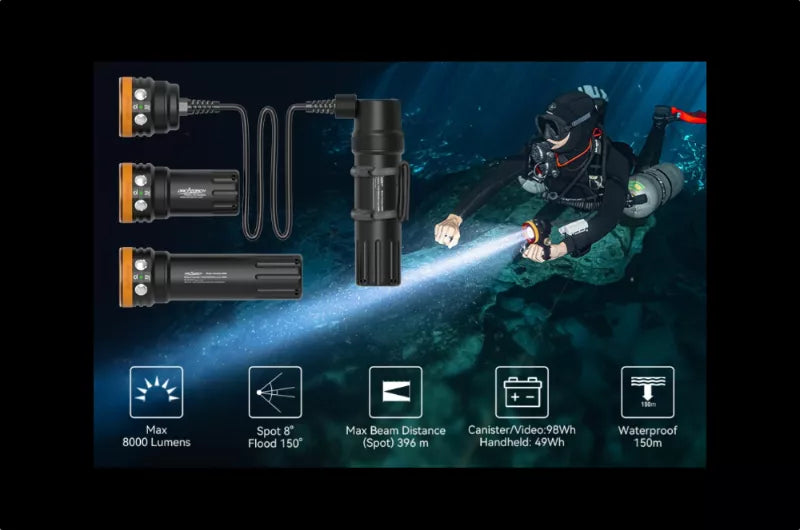
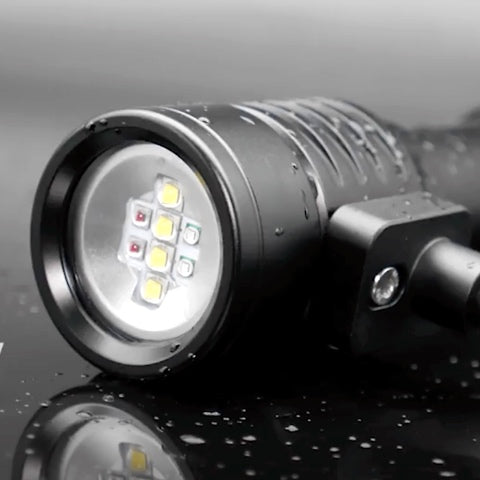
While the ZD710 offers full beam adjustability by simply twisting the light head, allowing you to fine-tune the beam angle anywhere between 4–72º, the FlexDive head takes a different approach with two dedicated beam options. It provides an 8º spot beam for signalling, low-visibility penetration, and detailed inspection work, alongside a powerful 150º flood beam for wide-area illumination.
However, some divers may find such a wide flood beam excessive in typical UK diving conditions, where lower visibility can increase backscatter. For maximum versatility, both beams can also be used simultaneously.
Price may also be a factor in purchasing this powerhorse. At the time of this review, UK RRP prices are £689.95 for the FlexDive Tec Canister Light, £549 for the FlexDive Video light, and £469.95 for the FlexDive Tec handheld light.
Modular Flexible Power
With this new dive light, OrcaTorch has introduced the FlexDive series as a modular system designed to adapt to various diving scenarios, featuring interchangeable light heads that enable flexible configurations for canister, handheld, and video setups.
Simply put, you have one light head that can be used as a video light with its own battery, a handheld light with a smaller battery, and a canister torch with a battery and umbilical cord. You can easily swap between batteries and configurations.
What OrcaTorch has also done with this new series is bring in the same 90-180º cable-angle adjustment from the canister, suitable for both sidemount and backmount (and rebreather) diving, similar to the popular Orcatorch D630.
Yet, the highlight of this system isn’t just its “modularity” but the amount of light it delivers at a consistent setting, without relying on short-term turbo modes, now referred to as a constant High Mode.

OrcaTorch FlexDive Lumens and Burn Times
8000lm output is a major leap for any dive light, especially when it isn’t short-lived. But one needs to be cautious that this appears to be only achievable when flood and spot modes are used together (a combination effect that means a relatively wide aura), even though, via the canister, that means 2h 25mins of burn time and, on a handheld battery, a whopping 65 minutes at this setting!
But hey, let’s not get overexcited, as what can be regarded as the normal High is equally impressive and likely even too much for some diving environments. Achieved when either Spot or Flood mode is chosen individually.
For ease of reading, we’ll refer to the batteries as canister and handheld. On Flood, the High is 6200Lm for 2h 40mins on canister and 1h 20mins on handheld. On Spot mode, unless used together with Flood, there’s no High reference, but the powerful 3000Lm on Mid provides over 5h burntime on canister and just under 3h on handheld.

Extraordinary runtime at around 1000Lm
And if, so far you’ve been using dive lights at around a non-negligible 1000Lm, in itself enough power for most diving conditions, you’ll be way impressed by this: If using the Flood mode wide beam at the Low setting of 1200Lm, you’ll get over 12 h burn time on a canister and 6 h burn time on a handheld.
“How about Spot?” you ask. Imagine 22.5 hours of burn time at 1000 Lm for the canister and just under 10.5 hours on the handheld battery! All we can say at this point is that, even with its heat-protection function that kicks in at 48C, make sure you don’t leave it on the surface for too long, switched on in a dive bag or the boot of a car, as this power monster certainly needs water for heat dissipation!
As a rule of thumb, we always treat advertised burn times with caution, given that they depend on various factors, including ambient temperature, battery life, charge cycles, etc., but even then, 80% of the claimed runtime is more than enough for any kind of diving.
FlexDive Battery Packs & Charging Options

All this power is supplied by rechargeable battery packs: The 49Wh B49 for handheld and the 98Wh B98 for the canister and video versions. OrcaTorch has ensured that both battery packs comply with airline carry-on regulations and can also serve as power banks (as with the D630). Meaning it can be used as a portable charger for your mobile phone, dive computer or cameras.
Obviously, the higher the ‘Wh’ rating, the longer it will take to charge a battery, but given the amount of burn time these lights will have, even an overnight charge would be acceptable.
And one needs to note that charging is achievable both via the tail magnetic charging and via the internal USB-C port – handy if you’re travelling and don’t have the magnetic charging cable.OrcaTorch describes the magnetic tail charging system as secure and corrosion-resistant, but some may be concerned about the exposed part.
According to the specifications, the B98’s USB-C charge time is 6 hours, whereas magnetic tail-end charging reduces it to 5 hours. Similarly, USB-C charges the B49 in 3 hours, which is reduced to 2.5 hours with the magnetic charger.
FlexDive System Dimensions

While not exactly any heavier than previous models, the FlexDive series is slightly larger. For comparison, the ZD710 light head diameter is 58mm, the D630 is 60mm, and the FlexDive dive and video light head diameters are 74mm.
For those used to the more streamlined light head of the D630, this head may feel bulkier in the hand and, in some ways, reminds us of the previous NW7 LFM light head manufactured in Poland (though with a lower profile).
According to the canister specs, it is 231mm tall with a diameter of 58mm, compared to 209 x 59mm for the D630 V2. The 58mm diameter also applies to the handheld and video versions, which are 151mm in length.
Is The OrcaTorch FlexDive Worth It?
Choosing the best OrcaTorch dive light now depends less on brightness alone and more on how you dive. The ZD710 MK2, D630 V2, and FlexDive each target different diving styles.
On paper, the OrcaTorch FlexDive Series is one of the most impressive dive lights the company has produced to date. It takes the proven reliability of previous OrcaTorch robust aluminium-bodied lights, retains the 150m depth rating, and introduces a level of flexibility we have not seen from the brand before.
The real question is not whether the FlexDive is powerful enough — with up to 8000 lumens, a large battery capacity, constant-output technology, and exceptional runtimes, that question has clearly been answered. Instead, it is whether every diver needs this level of power and modularity.
For many recreational divers, the excellent ZD710 MK2 remains one of the best-value handheld dive lights, particularly for its fully adjustable 4º-72º beam and compact design. Obviously, if you're looking for something more compact and with a fixed beam, there are many affordable but powerful handheld options such as the D710 or D700 - and even the newly released Orca 7.
Likewise, technical divers who prefer a traditional, dedicated primary light may still find the proven D630 V2 canister system, with its focused 7º beam, perfectly suited to UK wreck, cave, and low-visibility diving.

Where the FlexDive changes the game is versatility. One light head can become a powerful handheld primary, a wide-angle video light, or a serious umbilical canister system simply by changing the battery configuration. For divers who want a single premium light system that adapts as their diving evolves, that flexibility may justify the higher price.
Then again, if you're looking for a powerful video light and an umbilical canister torch, it's worth noting the B98 battery pack used for video and canister is identical. If you purchased the video pack, you can always order the optional cable that bridges the canister and light head. And if you purchased the canister, you can always screw it directly into the light head, so there's no need to get two sets of the same battery.
But it’s worth noting at this early stage of release that OrcaTorch is offering this light system initially in a preconfigured form: you can soon buy it as a canister, handheld, or video light. We expect first deliveries early to mid-July.
After or alongside that, the FlexDive head is expected to be available separately for UK RRP £229.95, together with the B49 short battery at £199.95, the B98 Long battery at £279.95, and the C98-Connection cord at £159.95.
Do we wish OrcaTorch had added full beam adjustment like the ZD710 MK2 rather than separate spot and flood modes? Absolutely. That could have made the FlexDive almost unbeatable.
However, combining huge output, long runtimes, fast battery swapping, dual charging, travel-friendly battery packs, and modular design, the FlexDive Series looks set to become OrcaTorch’s new flagship dive light system.
The final verdict? The ZD710 MK2 remains the focusable-beam handheld value champion, the D630 V2 remains the proven technical "canister" workhorse, but the FlexDive is OrcaTorch showing what happens when they decide to push the boundaries.
OrcaTorch FlexDive Key Specifications
- High-strength AL6061-T6 aluminium alloy body design
- Depth rating: 150 metres
- Light modes: 8º Spot / 150º Flood / Combined output
- Maximum output: 8000 lumens (Spot + Flood combined)
- Constant output technology
- Battery options: B49 49Wh handheld / B98 98Wh canister
- Magnetic tail charging + USB-C charging
- Battery packs can be used as power banks
- Adjustable 90º-180º (canister) cable connection
- Safety lock function
- Configurations: handheld, video light, umbilical canister light
You may also be interested in: