






Whether you’re diving nitrox or trimix, one rule should never change: analyse your own gas, record the result, and ensure the cylinder is correctly labelled before the dive.
Divesoft has become one of the best-known names in diving gas analysis, with analysers ranging from compact personal units through to equipment designed around professional gas-blending stations.
But the current range covers several quite different ways of size, shape and working.
Do you want a pocket-sized nitrox analyser that works through your phone? A completely standalone oxygen and helium analyser? Carbon-monoxide detection? Or an analyser intended to become part of a professional filling system?
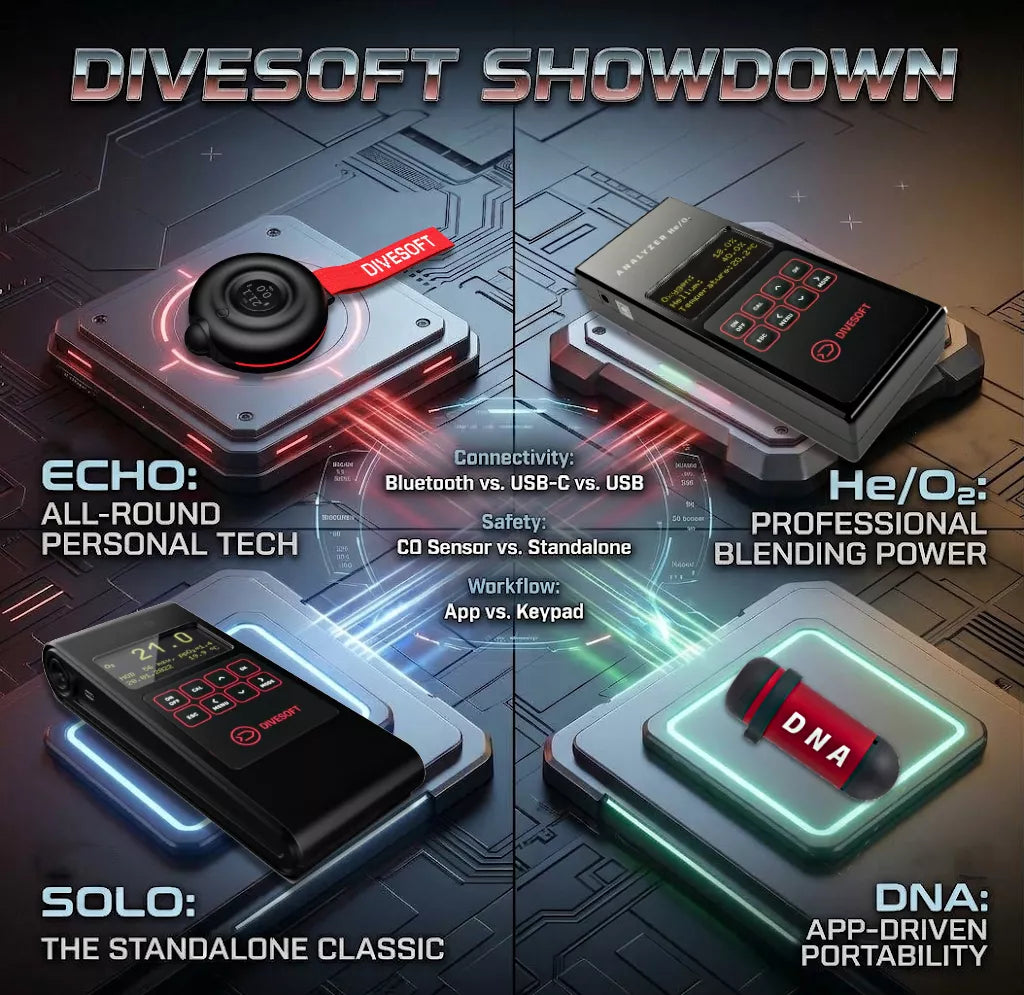
Starting with the most compact, travel-friendly units, we compare the Divesoft DNA, SOLO O₂, SOLO, ECHO, and He/O₂, and explain the key difference between the two ECHO oxygen-sensor options.

The Divesoft Analyser Range
Before looking at each analyser, note that the Divesoft DNA and SOLO O2 are nitrox-only analysers and will not analyse for helium (or CO), while the SOLO, ECHO, and He/O₂ are trimix analysers. Only the truly portable, low-profile ECHO also has a dedicated carbon monoxide (CO) sensor.
Prices? You ask. Without any add-ons or accessories, going by unit price from low to high, the price hierarchy is essentially: DNA → SOLO O₂ → SOLO → ECHO Standard → He/O₂ → ECHO Solid State
With that said, let's dive into the details:
Divesoft DNA Nitrox Analyser

At the start of the scale is the portable, lightweight and tiny Divesoft DNA.
The DNA is an oxygen analyser designed around a smartphone rather than its own conventional display.
It measures oxygen but does not measure helium or carbon monoxide.
Instead of an OLED or TFT screen, the Divesoft App displays the analysis, and the analyser sends it to your phone via Bluetooth.
The Divesoft comparison also identifies app-based data handling and cylinder-label printing as part of the DNA workflow.
That makes the DNA particularly interesting for travelling nitrox divers who value minimum bulk and are comfortable using their phone as the display and logging device.
However, it isn't a trimix analyser. While its appeal is its small, straightforward design, you will need your mobile phone to use it. If you're looking for true portability and reliability, without relying on your phone's charge level or presence, we'd strongly recommend the Divesoft ECHO analyser, which would future-proof you for mixed gas diving.
The ECHO can be used as a standalone unit while still linking to the Divesoft app for extended data display and management, blending tools, and label printing through the phone.
Divesoft SOLO O2 - Nitrox Analyser

The SOLO O₂ is Divesoft’s more traditionally shaped standalone nitrox analyser. It measures oxygen content but not helium. In that respect, like the DNA, it is a nitrox analyser, but with its own screen and no mobile phone required to operate.
According to Divesoft's own comparison, it retains the familiar SOLO format with:
- Oxygen measurement
- Bright OLED display
- Rechargeable battery
- USB-C connectivity
- USB serial data capability
That makes the SOLO O₂ particularly relevant to recreational nitrox divers, instructors, dive boats and other users who want a traditional standalone oxygen analyser without paying for trimix-analysis capability they are unlikely to use.
If you know you will never need to measure helium, keeping things simple has obvious attractions.
Divesoft SOLO Trimix Analyser

The Divesoft SOLO also follows the more traditional Divesoft analyser format and measures both oxygen and helium, making it suitable for nitrox and trimix analysis.
But unlike the ECHO, which we cover below, it doesn't include carbon monoxide detection.
Its interface is deliberately more conventional:
- Bright OLED display
- Physical keypad
- Rechargeable battery
- USB-C connection
- Built-in analyser functions
For divers who would rather operate an analyser directly than use a phone-based workflow, that simplicity may be an advantage.
The SOLO is therefore not simply an older version of the ECHO. It represents a different approach: a self-contained oxygen-and-helium analyser with its controls and information available directly on the unit.
Divesoft ECHO Trimix Analyser(s)

The Divesoft ECHO is the most compact, travel-friendly trimix analyser on the market and the only analyser in this comparison with a dedicated CO sensor.
The ECHO is designed around Bluetooth Low Energy and the Divesoft App. The app can display and store gas analysis results, manage cylinders, perform gas calculations, and generate cylinder labels.
The app handles label printing. It creates a PDF you can share with a compatible printing app or a printer connected to the phone.
The ECHO's CO sensor is particularly useful when travelling, when using an unfamiliar compressor, or when checking fills in locations where air-quality procedures are unknown. Carbon monoxide cannot be reliably detected by sight, smell or taste, and its partial pressure increases with depth.
However, do not treat the CO feature as fully automatic. The sensor requires calibration and functional testing. Divesoft recommends calibration at least every six months and a bump test before a dive trip or operational deployment. The sensor has a rated life of approximately two years and must be replaced through an authorised service point.
The ECHO therefore provides an important additional check, but only if the CO sensor is properly maintained and tested.
Before comparing the two ECHO units, it's worth clearing up one potential source of confusion. The manufacturer offers the ECHO with two oxygen-sensor technologies, reflected in their respective price points. The difference is in the sensors, while all functions are similar.
For most people, we would start with the ECHO Standard.


ECHO Standard – Galvanic Oxygen Sensor
You get the same core oxygen, helium, and CO measurement capability with the standard ECHO, but with a less expensive, replaceable R22S galvanic oxygen sensor and substantially longer quoted battery runtime.
The O2 sensor is user-replaceable and relatively inexpensive, but like other galvanic oxygen cells, it is a consumable item. Divesoft indicates an expected working life of approximately 12–24 months, depending on use, storage and environmental conditions.
With the galvanic sensor fitted, Divesoft quotes up to 100 hours of battery operation.
For many recreational and technical divers, this is likely to be the most straightforward ECHO option.
ECHO Solid State
The ECHO Solid State replaces the galvanic cell with Divesoft's DVO₂ solid-state optical oxygen sensor.
The Solid State ECHO becomes particularly attractive if the analyser will see frequent use or you intend to keep it for many years.
Divesoft describes the optical sensor as potentially lasting for the analyser's working life in normal personal use, with an expected life of more than ten years even in intensive dive-centre or filling-station operation.
It still requires calibration — Divesoft recommends checking and calibrating it periodically, approximately every six months or when its reading in air differs significantly from the expected value.
Yet, avoiding regular replacement of the primary oxygen cell can be valuable for:
- Frequent technical divers
- Expedition teams
- Dive instructors
- Dive centres
- Gas-blending operations
- Owners who simply dislike relying on the condition and age of a galvanic cell
However, the initial cost is considerably higher, and the optical sensor halves the quoted battery runtime from 100 hours on the standard to 50 hours.
For most trips, 50 hours of analyser operation is still a substantial amount.
And remember: the solid-state O₂ sensor may be exceptionally long-lived, but the separate electrochemical carbon-monoxide sensor remains a consumable component.
Divesoft He/O₂ Trimix Analyser

The Divesoft He/O₂ occupies a very different position as Divesoft’s blending-station-oriented (professional) model.
It measures oxygen and helium, but its real advantage is not another gas sensor. It is the analyser's ability to become part of a professional gas-blending and filling system.
Functions include:
- Continuous gas analysis
- Adjustable monitoring limits
- Audible alarms
- Relay output for emergency compressor shutdown
- Gas-mixing calculation functions
- USB data output
- TTL UART connectivity
- Cylinder-label printing capability with suitable equipment
These functions matter far more in a working dive centre or any blending station than minimum weight or smartphone integration.
Divesoft's own comparison consequently describes the He/O₂offering continuous monitoring, alarm functions and compressor-shutdown integration, as primarily intended for professional gas blending and dive-centre use, and notes that although it can travel, it is the heavier option in the range.
Divesoft Trimix Analyser Differences at a Glance
1. Carbon Monoxide Detection
The ECHO is the only analyser in this comparison with a dedicated CO sensor. It measures from 0 to 100 ppm and has an alarm threshold of 5 ppm.
2. Helium Measurement
All four analysers, SOLO, ECHO standard, ECHO Solid State and He/O2, determine helium concentration using the speed of sound through the gas rather than a consumable helium cell. This gives the helium-measuring system a very long service life and removes the recurring cost of a replaceable helium sensor.
“Non-consumable” does not mean infallible. Accurate results still depend on correct calibration, controlled gas flow, suitable sampling conditions and use with the gas combinations for which the analyser was designed.
3. Mobile vs. Stanalone Workflow
The ECHO is designed around Bluetooth Low Energy and the Divesoft App, but you can also use it as a standalone unit.
The SOLO is more self-contained. Its display, keypad and built-in tools suit divers who want to work directly on the analyser, with USB-C used for charging and data transfer.
The He/O₂ goes further in the opposite direction. Its interfaces, continuous-analysis mode, alarms and relay output make it better suited to integration with a professional blending station.
4. Size and Travel Practicality
At approximately 288 g including its strap, the ECHO is the lightest and most compact helium-capable analyser in this comparison. Its HR-TFT display is designed to remain readable in bright conditions, and its integrated strap allows it to be secured to a cylinder or worn on the wrist while working.
The SOLO remains portable but uses the more traditional, larger, rectangular Divesoft format.
The He/O₂ is primarily intended for a dive centre, a boat, or a filling station. It can be transported, but portability is not its main advantage.

Which Divesoft Analyser Should You Buy?
For the smallest app-based nitrox solution — DNA
For travelling nitrox divers where size matters most, the DNA offers an extremely compact solution. It sacrifices helium capability and its own conventional display in favour of Bluetooth communication with the Divesoft App.
For standalone nitrox analysis — SOLO O₂
If you only dive air and nitrox and want a dedicated analyser with its own display and controls, the SOLO O₂ gives you the traditional Divesoft format without paying for helium measurement.
For traditional standalone trimix analysis — SOLO
Choose the SOLO if you want oxygen and helium analysis but prefer physical controls, an integrated screen and a conventional standalone analyser. It remains particularly attractive to divers who simply don't want a smartphone to become part of the gas-analysis process.
For travelling technical and trimix divers — ECHO Standard Set
For most individual technical divers, the ECHO Standard with Professional Flow Limiter Mk2 is probably the strongest all-round package. You get oxygen, helium and CO analysis, excellent portability, long battery life and integration with Divesoft's mobile workflow.
The replaceable galvanic O₂ cell also keeps the initial purchase price below the Solid State version.
For frequent users and long-term ownership — ECHO Solid State
If you regularly analyse gas and would rather avoid replacing a galvanic oxygen cell every year or two, the ECHO Solid State becomes much easier to justify. Its long-life optical oxygen sensor is the principal reason to choose it.
For dive gas blending and dive centres — He/O₂
The He/O₂ makes most sense where gas analysis forms part of the filling process itself. Continuous monitoring, alarms, data connections and compressor-shutdown integration are features designed around a professional filling environment rather than an individual diver checking a cylinder before a dive.
Divesoft: Final Verdict
There isn't one "best" Divesoft analyser because the five products are designed for different jobs.
ECHO is the broadest-featured portable option and the only one in the range that combines oxygen and helium analysis with dedicated carbon monoxide detection.
SOLO provides traditional standalone oxygen and helium analysis.
SOLO O₂ strips the same basic concept back to nitrox and oxygen checking.
DNA takes the opposite approach, using Bluetooth and a phone to create an exceptionally compact nitrox analyser.
And the He/O₂ is the specialist instrument in the range, designed primarily for professional filling and continuous gas-monitoring applications.
For the ECHO itself, the final decision is between the economical, replaceable galvanic oxygen sensor of the Standard version and the substantially longer-lived optical sensor of the Solid State.
Whichever analyser suits your diving, the instrument is only part of good gas-management practice. Correct sampling, calibration, independent checking, clear cylinder labelling and appropriate dive planning remain just as important.
Safe Diving!